
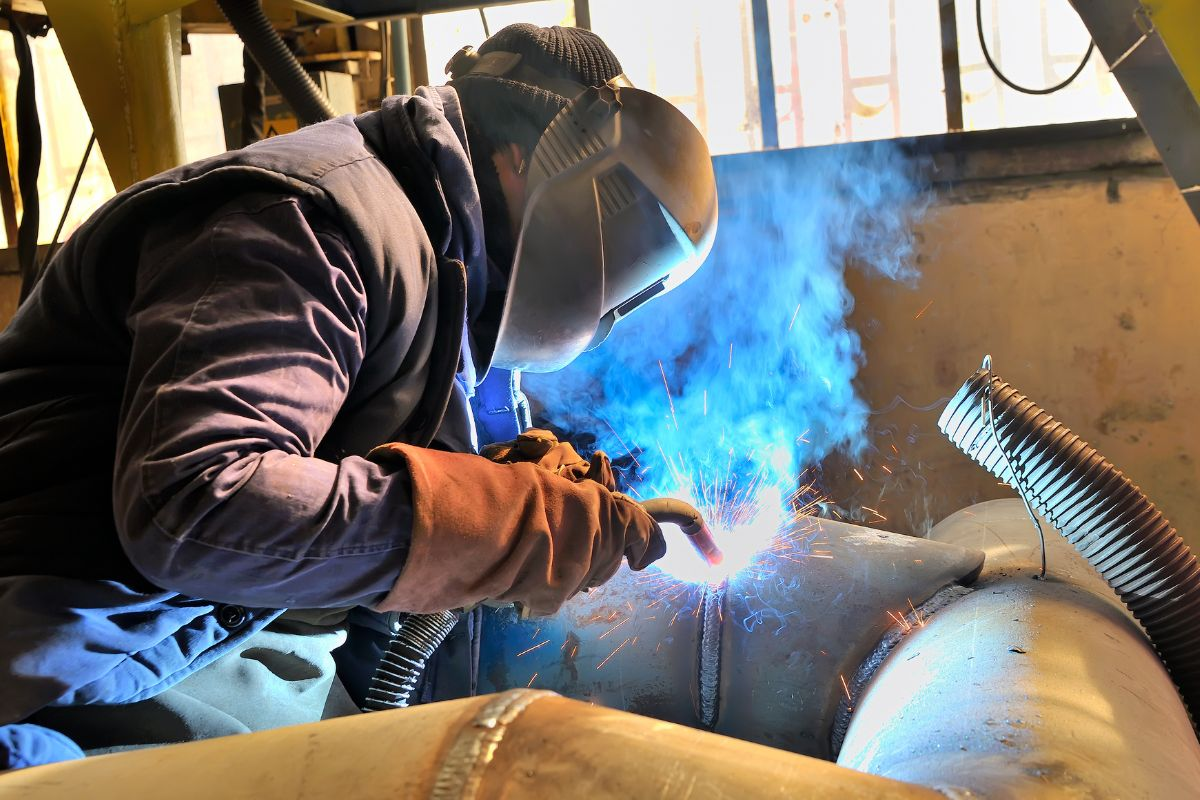
When you're choosing between welding methods for your next project, understanding the differences between TIG and MIG can save you time, money, and headaches.
Both processes have their place in the industry, from mining equipment repairs to precision welding services for transport and civil applications. The right choice depends on your material, budget, production volume, and quality requirements.
Metal Inert Gas (MIG) Welding Overview
Metal Inert Gas (MIG) welding uses a consumable wire electrode that feeds continuously through a welding gun. The electric arc melts both the wire and the base metal, creating a weld pool that fuses the materials. A shielding gas protects the molten metal from atmospheric contamination.
The process is semi-automatic, meaning the welder controls the torch position and travel speed whilst the wire feeds at a preset rate. This makes MIG welding faster and more forgiving than many other welding methods. It works well on mild steel, stainless steel, and aluminium, though each material may require different wire types and gas mixtures.
Pros of MIG Welding
- Speed and productivity: In spray transfer mode, MIG welding can deposit 3-5kg of weld metal per hour, letting fabricators fill joints quickly and keep production moving.
- Easier learning curve: The automatic wire feed makes MIG simpler to master than TIG.
- Versatility with thicker materials: MIG handles thick sections and structural steel efficiently, making it the go-to process for heavy fabrication work.
- Lower equipment costs: Entry-level MIG machines and consumables are generally less expensive than TIG setups.
- One-handed operation: The MIG torch requires only one hand, leaving the other free to position the work or hold the welding gun steady.
Cons of MIG Welding
- Less precise control: The continuous wire feed and faster travel speeds make fine detail work more challenging.
- Weld aesthetics: MIG produces a rougher weld bead that often requires light polishing or grinding for a finished appearance.
- Spatter and cleanup: MIG generates more spatter than TIG, particularly on shorter arc lengths, increasing post-weld cleanup time.
- Limited position flexibility: Overhead and vertical welding can be trickier with MIG due to the larger weld puddle and faster deposition.
- Porosity risks: Improper shielding gas coverage or contaminated base metal can lead to weld bead porosity and defects.
Tungsten Inert Gas (TIG) Welding Overview
TIG welding uses a non-consumable tungsten electrode to create the arc. The welder holds a TIG torch in one hand and feeds a separate filler rod into the weld pool with the other. A foot pedal controls the heat input, allowing precise adjustment throughout the weld. Pure argon serves as the inert gas shield.
The TIG welding process demands more coordination and skill than MIG. You're managing the torch angle, filler rod feed rate, travel speed, and amperage simultaneously. However, this control produces exceptionally clean, strong welds with minimal distortion. TIG works across nearly all metals, including thin sheet metal, exotic alloys, and cast iron.
Pros of TIG Welding
- Superior weld quality: TIG welding produces joints that are usually stronger and more precise than MIG, with very little heat-affected area.
- Excellent for thin materials: TIG's fine control prevents burn-through on sheet metal and delicate components.
- Clean, aesthetic welds: The precise arc shape and controlled filler material produce smooth, attractive weld beads that rarely need finishing.
- No spatter or slag: TIG creates virtually no spatter, eliminating cleanup time and reducing material waste.
- Ideal for aluminium and stainless steel: Our aluminium fabrication specialists rely on TIG for corrosion-resistant applications in mining and marine environments.
- All-position capability: TIG welders can work comfortably in any position, including overhead and vertical.
Cons of TIG Welding
- Slower production: Manual TIG deposition rates average just 0.6-1.30 kg/hr, making it impractical for long runs or high-volume work.
- Steep learning curve: TIG welding requires significant dexterity, hand-eye coordination, and practice. The two-handed technique plus foot pedal operation takes time to master.
- Equipment investment: TIG machines, tungsten electrodes, foot pedals, and gas cylinders represent a larger upfront investment than MIG setups.
- Contamination sensitivity: Tungsten oxide formation and weld defects occur easily if the shielding gas coverage lapses or the tungsten touches the weld pool.
MIG vs TIG Welding: Side-by-Side Comparison
The practical differences between these welding methods show up clearly in Australian workshop economics. Western Australia's resources sector, which posted record $238 billion sales in 2023-24 according to the WA Government, drives sustained demand for rapid, high-deposit MIG and flux cored arc welding (FCAW) on heavy equipment maintenance. TIG remains essential for precision work on stainless steel and aluminium components.
Productivity
A MIG spray process completes a 6mm fillet weld faster than TIG. For mining maintenance planners working to tight shutdown windows, this speed advantage is critical. MIG and flux core methods keep equipment downtime to a minimum.
Cost
Labour represents the largest expense in both processes. Combined with slower travel speeds, TIG's total cost per metre of weld runs significantly higher.
Quality and Strength
TIG produces superior weld penetration, finer grain structure, and better mechanical properties. For civil and transport industries requiring aesthetic stainless or aluminium welds, TIG delivers the appearance, distortion control, and compliance documentation needed for site inspections. MIG welds are perfectly adequate for structural applications but lack TIG's precision and finish.
Choosing the Right Welding Process Based On Your Application
Thin Materials and Sheet Metal
TIG is the clear winner for anything under 3mm. The precise heat control prevents warping and burn-through. Aluminium sheet work, stainless enclosures, and decorative metalwork all benefit from TIG's clean results.
Thick Sections and Structural Steel
MIG handles heavy plate and structural members far more efficiently. For mining equipment repair work, earthmoving parts, and transport frames, MIG's deposition rate and penetration on thicker metals make it the practical choice.
Aesthetic and Precision Work
When appearance matters, TIG produces welds that need minimal finishing. Handrails, architectural features, food-grade stainless equipment, and visible welds all justify TIG's higher cost through reduced grinding and polishing time.
High Volume Production
MIG's speed advantage compounds over long production runs. Batch fabrication, repetitive assemblies, and high-volume manufacturing favour MIG or even fully automatic arc welding systems. The faster wire feed speed and simpler technique keep costs manageable.
Material Specific Considerations
Aluminium welding typically requires TIG for quality results, though a spool gun on a MIG welder can work for thicker sections. Cast iron repairs often need TIG's controlled heat input to prevent cracking. Mild steel accepts either process, so productivity and cost usually drive the decision.
Get Professional Welding Solutions With Weld East Fabricators
Need fast, strong welds, or precise, detailed joints? At Weld East Fabricators, our experienced team brings over 40 years of certified welding experience to mining, civil, and industrial projects across Western Australia.
Contact us today to discuss your project and get the job done properly.
Frequently Asked Questions
Should a beginner welder use MIG or TIG?
MIG is widely regarded as easier to learn because the wire electrode feeds automatically. Beginners can produce acceptable welds much faster with MIG than with TIG. The simpler one-handed technique and forgiving arc make MIG the better starting point for most people.
Which is harder to learn, TIG or MIG welding?
TIG is harder to learn. The process requires two-hand coordination (torch and filler rod), foot pedal control for amperage, and careful attention to torch angle and travel speed simultaneously. MIG's automatic wire feed and simpler technique allow faster skill development.
Can TIG do everything MIG can?
No. Whilst TIG produces higher quality welds on thin or exotic metals, it's impractically slow and costly for long, heavy fillet welds on structural steel. Both welding methods have unique strengths. MIG excels at productivity and thick materials, whilst TIG delivers precision and aesthetics. The right welding process depends on your specific application.